
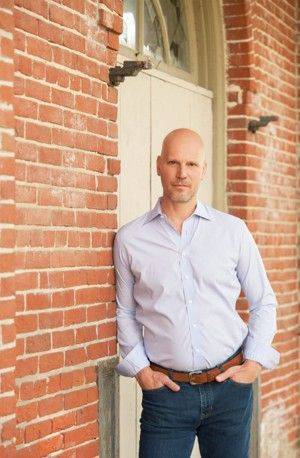
MY CLOCKING OUT STORY
Raymond Lee
HR Professional to Entrepreneur
My mom named me after my grandfather, Raymond Brechtel. He went by Ray, but I never did, because my mom made sure of it. It's always been Raymond. When I was in trouble, it was Ray-MUND. When I was in real trouble, it was Raymond Michael Lee.
I heard that full name a lot growing up.
I grew up just outside of New Orleans being raised by my mom primarily, as my dad was in the military and traveled quite a bit. They divorced when I was around 8, so it was just me and my younger brother David.
I wasn’t the best kid growing up. One memory I had of my mischievous childhood was riding my bike around the neighborhood and switching everyone's mail. I'd take one neighbor's mail, ride two blocks down the street, and drop it in someone else's mailbox. By the end of the day the parents were scurrying around comparing notes, and they figured out that every house had the wrong mail except one, ours. I hadn't switched our own, which led to me getting in serious trouble.
I managed to make it through high school, but only got a 17 on my ACT, so my college choices were limited. I ended up attending Southeastern Louisiana University, a small state college, and I chose Psychology as a degree primarily because my high school guidance counselor said I was great with people and felt like I’d be a good therapist. So, I took that advice and majored in Psychology, then later went to graduate school to pursue a degree in Industrial/Organizational Psychology, which is the study of behavior in the workplace. I really wanted to be in business, not in the medical field, so this graduate degree was a must.
- • •
For some reason, I buckled down in graduate school and finished with a 4.0 GPA in just a year and a half. At this point, I was very motivated to begin my career, but there was one problem. A couple months after graduation, I saw my dad on the front page of the business section of the New Orleans newspaper. He had been convicted of mail fraud and was close to serving prison time.
My dad ultimately was found guilty and would be serving two years in federal prison. Preparing for his two-year sentence, he sat me down and asked me for three things.
- Drive him to federal prison, which was about 4 hours from New Orleans to Eglin Air Force Base where he would serve a two-year sentence.
- Live in his apartment and look after his affairs.
- Run his insurance book of business while he was gone.
I couldn't say no, so in April of 1995, my brother and I drove my dad from New Orleans to the federal prison at Eglin Air Force Base in Fort Walton Beach, Florida. It was one of the most emotional drives of my life.
A month later, New Orleans flooded. It wasn't Katrina, but it was massive, and suddenly my phone was ringing with policyholders who needed help. I was filing claims, scheduling adjusters, and sitting across the table from people with decades more experience than me.
When my dad came home from prison, it was time to find a job. I landed an HR job with a small construction company in New Orleans and spent about four years there before realizing I needed to leave my hometown.
Around 1999, I got a job with Corning, the glass company, at a site in Scranton, PA, the place where The Office was filmed. Leaving my mom was one of the hardest things I had to do. She was my rock.
About a year after I arrived at Corning, the dot-com bubble burst and the layoffs started. I went from hiring to firing. I didn’t know it at the time, but it would be this layoff experience that would ultimately give me the idea of the business behind Careerminds.
I ended up leaving Corning and took another corporate human resources job for five years before realizing HR just wasn’t fulfilling for me, so I negotiated my exit, hired my replacement, and “clocked out.”
- • •
Careerminds was born. I started Careerminds as a recruiting company, but that changed very quickly. In October 2008, Lehman Brothers collapsed, and it was the start of the financial crisis and the recession.
Every company in the US was either not hiring or was laying off. One of my early clients, Theater Extreme, called me to announce they had just lost their funding and were filing for bankruptcy, so no more recruiting. They did, however, ask me if I could help their employees who were impacted by a layoff find a job. And that is when the light bulb went off: this would be my new business. Outplacement services.
I thought back to my Corning days, where people walked into an office to meet face to face with career coaches and resume writers and used desktop computers and fax machines. I asked myself whether we could do it differently, by building a virtual delivery platform. So that’s what we did: we built an outplacement platform that became our virtual outplacement delivery model.
- • •
As I got started as an entrepreneur, I was feeling imposter syndrome as "Founder and CEO" didn't roll off my tongue so eloquently. I was scared to get on stage to talk about my company, and I was insecure about selling my services. What got me through all of this was humility and perseverance, two qualities I learned from my mom.
We had a big problem; HR buyers were not ready for virtual delivery. We were too early for the market, so to grow and scale we would need funding. I didn’t have experience raising venture capital, and I was afraid to present. I took a public speaking course with “Own the Room” and quickly got comfortable presenting to large groups of people. I had to immerse myself in it and get over the fear. I then went on the road and pitched over 75 venture capitalists looking for anyone who would write me a check.
One investor in Delaware had a connection to Jack Gavin, who was the former president of Right Management, one of the largest brick-and-mortar outplacement firms in the world and a fierce competitor. If Jack believed in my idea, the investor would write a check. The meeting was a huge success, and in May of 2011, we closed a Series A round of close to $2.5 million, and Jack became chairman of our board. Signing over 50% of Careerminds was one of the hardest decisions I had to make. My mom was integral to that decision. She asked me, “Would you prefer owning a small piece of something big, or zero percent of nothing?” It was the best advice I ever received.
The investment capital got us to profitability around 2014, and by 2019, we had built a nice business with steady growth, but we were faced with another problem. We were approaching a decade and our early-stage investors wanted to know what was next. They wanted to sell Careerminds, but we didn’t have a buyer. It was 2019, unemployment was low, and there just wasn’t a market for a virtual outplacement company.
Three months later, March 2020 happened and the world shut down. I never thought in a million years it would take a global pandemic to put Careerminds on the map, but that's what it did. Over the next two years, Careerminds scaled to one hundred countries in eighty languages, and the large brick-and-mortar firms responded to the pandemic by closing offices.
Two years later, in March of 2022, we were approached by a company owned by the private equity firm Boston Ventures, with interest in the company. After months of back and forth and a long due diligence, we sold Careerminds.
Today, I still lead Careerminds as President and I have a podcast called Clocking Out with Raymond Lee. The podcast features stories of individuals who have “clocked out” of a career or job that is not fulfilling or aligned with their values. They share their early childhood years, personal stories, career journeys, clocking-out moments, and the lessons learned along the way.
The podcast is dedicated to my mom, who has been an inspiration to me, my life, and my career. I have made it a mission to help people find fulfillment, meaning, and purpose in their life and work. You can find parts one and two of my clocking out journey here.


